When you decide to keep a cat indoors, you grant them safety from cars, predators, and disease. You also take on a profound responsibility: becoming the sole source of their natural world. The great myth of the domestic house cat is that they are lazy, self-sufficient creatures who prefer a life of cushioned solitude. The reality is that your cat still operates with the mind and body of a hunter, requiring the mental and physical challenge that their wild ancestors sought every single day.
A bored, sedentary cat is not a happy cat; they are a cat whose mind and body are slowly deteriorating. Left without proper stimulation, the indoor environment can lead to a host of problems, including obesity, aggression, destructive behaviors, and stress-related illnesses. The core challenge for every owner is how to translate the vast, complex, and unpredictable outdoor environment into a structured, safe, and stimulating space.
This guide is for the owner determined to maximize their indoor cat health. We will move beyond just basic toys and explore detailed strategies for nutrition, habitat design, play scheduling, and mental enrichment. By focusing on the primal needs of your feline companion, you can ensure they remain vibrantly active indoors for years to come.
The Foundation: Nutrition as a Primal Stimulant
You cannot effectively keep a cat active indoors if their diet is actively working against their biology. The first and most critical component of indoor cat health is a high-quality, biologically appropriate diet. Cats are obligate carnivores, meaning they must consume meat to thrive.
Why Wet Food Wins for Indoor Cats
Obesity is the number one health crisis for indoor cats, leading to diabetes, joint pain, and reduced mobility. A dry kibble diet contributes to this in two ways: first, it is often calorie-dense and high in carbohydrates, which a cat’s system is poorly designed to process. Second, and crucially, cats have a low thirst drive. In the wild, their moisture comes almost entirely from their prey.
Dry food forces your cat to supplement their moisture intake, a task they often fail at, leading to chronic mild dehydration which stresses the kidneys and urinary tract. A wet food diet, which naturally contains 70 to 80 percent water, keeps the urinary system flushed and helps a cat feel fuller on fewer calories. This simple shift is the single greatest preventative measure against many common indoor cat health issues.
The Power of Food Puzzles
Once you address what your cat eats, you must address how they eat. In nature, a cat hunts six to ten small meals a day. When we simply pour food into a bowl, we remove the most stimulating part of their day: the hunt.
Introducing food puzzle toys—devices that force a cat to manipulate, roll, or bat the container to dispense small amounts of kibble or treats—reintroduces the concept of work-to-eat.
- Why it Matters: A study published in the Journal of Feline Medicine and Surgery demonstrated that environmental enrichment, particularly puzzle feeding, significantly reduced behavioral issues like anxiety and aggression in house cats.
- Case Study Example: Consider Luna, a nine-year-old tabby who had become withdrawn and overweight after her owners switched to a free-feeding dry food system. After introducing two different types of food puzzles, forcing her to work for her entire daily kibble portion, she began losing weight. More importantly, her owners reported she was less demanding at 3 AM because she was mentally tired from her “hunting” efforts during the evening.
Start with simple, open-top puzzles and slowly graduate to more complex, multi-stage dispensers. This makes mealtime an enriching game, not a boring, passive event.

Habitat Design: Translating the Wild into the Home
Your home must be more than a flat, two-dimensional space. Cats are arboreal hunters, meaning they naturally seek height for safety, observation, and ambush. To keep your cat active indoors, you must leverage the vertical space in your home.
Vertical Territory and Cat Superhighways
Every healthy indoor cat needs access to high vantage points that are easily reachable. This creates a vertical territory that gives them confidence and reduces territorial stress, especially in multi-cat households.
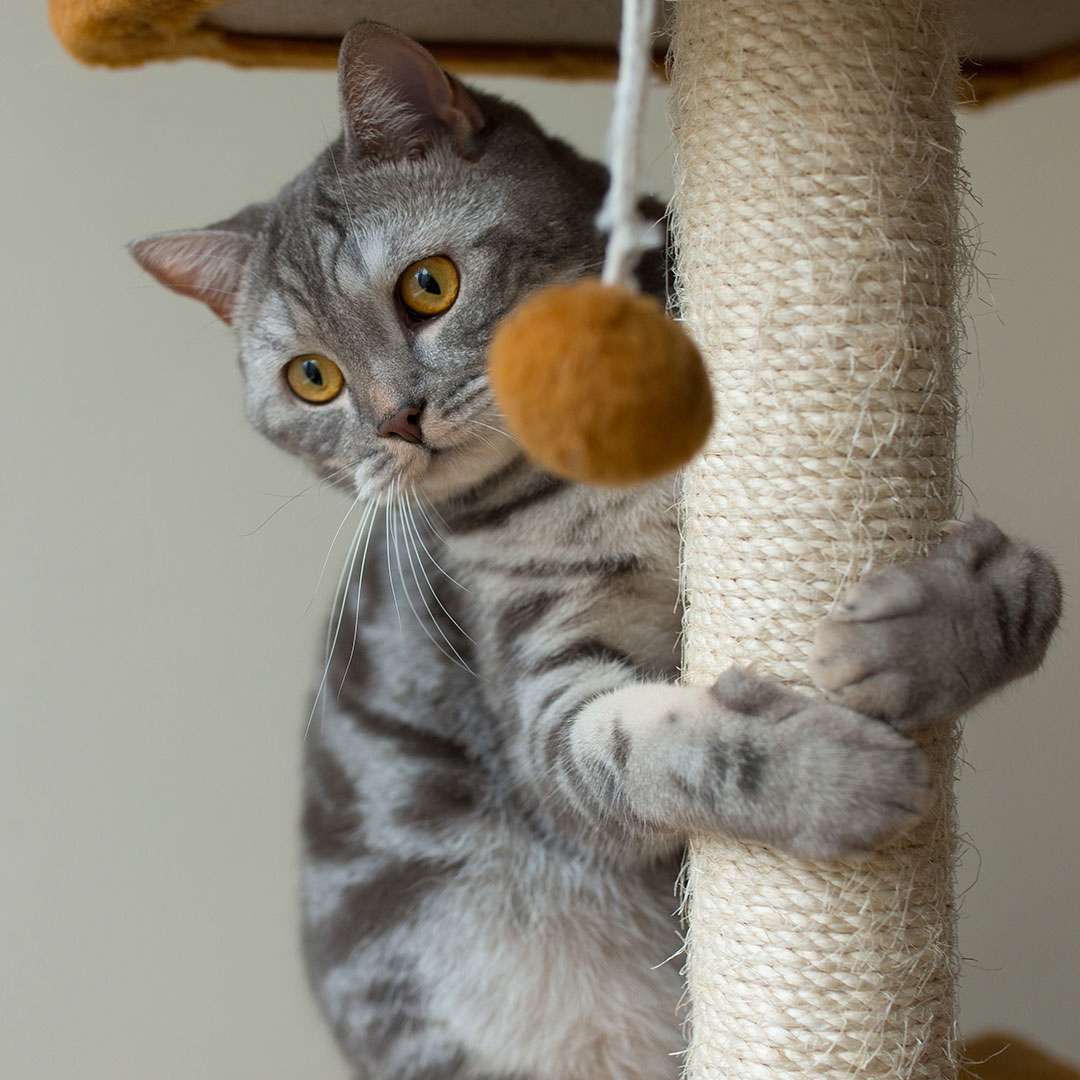
- Cat Trees and Towers: These are essential, providing scratching surfaces, napping spots, and height. Place them near a window, which serves as a natural “cat television” that offers passive environmental enrichment.
- Wall-Mounted Shelves: The emerging trend of creating “cat superhighways” involves installing a series of attractive, staggered shelves, ramps, and platforms high on a wall. This turns a boring wall into an obstacle course, encouraging climbing and leaping behaviors that directly address the need for physical activity.
- Window Perches (Catios): For maximum stimulation, a secured window perch or a dedicated, netted outdoor enclosure (a “catio”) provides safe access to smells, sights, and sounds, dramatically lowering the sense of confinement.
The Importance of Scratching
Scratching is not a destructive behavior; it is vital communication, territory marking, and muscle conditioning. Cats scratch to stretch their spine and paws, to shed old nail layers, and to deposit scent. Providing appropriate scratch surfaces is crucial for both mental and physical indoor cat health.
Provide a mix of textures and orientations:
| Scratching Surface | Purpose | Placement |
| Sisal Rope Post | Vertical stretch, spine alignment | Near a favorite resting spot or doorway |
| Cardboard Mat/Box | Horizontal paw conditioning, kneading | On the floor in a high-traffic area |
| Wood/Carpet Surface | Varying texture stimulation | Near furniture you want to protect |
The key is placement. Place scratchers near doorways, couches, or corners where your cat already spends time or has attempted to scratch. Make it easy for them to choose the right thing over the wrong thing.
Intentional Play: Scheduling the Hunt-Catch-Kill Cycle
Many owners simply toss a toy to their cat and walk away. While this offers momentary distraction, it fails to fulfill the cat’s deep-seated need to complete the predatory sequence: hunt, catch, kill, and consume (which we mimic with a treat). The most effective way to keep a cat active indoors is through structured, intentional play sessions.
The Daily Double: Morning and Evening Sessions
Cats are crepuscular, meaning they are most active at dawn and dusk. Schedule your intense play sessions around these times to align with their natural biological clock.
- Morning Session (5-10 minutes): A quick session before your breakfast. This burns energy and stimulates their appetite before you leave for the day, reducing the likelihood of boredom-related destructive behavior.
- Evening Session (10-15 minutes): The crucial session, scheduled right before dinner. This mimics the successful evening hunt, allowing them to expend their highest energy, eat their “kill” (dinner), and enter a natural rest cycle. This greatly helps with night-time hyperactivity.
The Best Toys for Indoor Cats
When selecting best toys for indoor cats, think motion, sound, and unpredictability. Avoid toys that are static or too easily captured.
- Wand Toys (The Essential Tool): Feather wands or toys on a string are the best investment. They allow you to simulate the erratic, unpredictable movement of prey—flitting, pausing, hiding, and darting away. Never let your cat play with the wand unsupervised, as they can ingest string.
- Rolling Prey (The Chase): Simple toys like ping-pong balls, lightweight plastic springs, or crinkle balls move erratically on hard floors, satisfying the need for a low-profile chase.
- The Power of Sound and Scent: Simple catnip mice, toys that rattle, or even a paper bag (with handles removed for safety) provide stimulating sensory input that engages different parts of the brain.
- Laser Pointers (Use with Caution): A laser pointer is excellent for intense bursts of activity, but it must always end with a catch. The inability to physically capture the “prey” can lead to frustration and redirected aggression. Always finish the session by immediately shining the light onto a physical toy or treat that the cat can pounce on and “kill.”
Mental Enrichment: Beyond Physical Activity
Physical activity is only half the battle. A truly active indoor cat needs deep, consistent mental stimulation to prevent anxiety and destructive habits. This is where you become the environment designer, providing variety and novelty.
Harnessing Novelty and Rotation
The cat brain requires novelty. A toy that sits on the floor for a week becomes part of the furniture. To maintain a state of curiosity, implement a strict toy rotation system.
- Keep 75 percent of your cat’s toys hidden away.
- Swap out the available toys every two to three days.
- When a “new” toy appears, it often smells and feels exciting again, renewing your cat’s interest.
This simple routine keeps the environment feeling fresh and maintains high interest in even the most basic items.
The Scavenger Hunt
Hiding food and treats is a simple, effective method of passive enrichment that engages their superior sense of smell and their natural drive to hunt.
- Hide small amounts of treats (or kibble, if you are dry-feeding) on low shelves, beneath towels, or inside paper bags.
- Place treats on different levels of the cat tree.
- Start easy, placing treats in plain sight, and slowly increase the complexity.
This transforms your home into a daily scavenger hunt, turning passive space into an active landscape of smells and rewards.
Training and Communication
Cats are highly intelligent and respond well to positive reinforcement training. Teaching simple tricks provides crucial mental exercise and deepens your bond.
- Clicker Training: Use a clicker paired with a high-value treat to mark desirable behaviors.
- Targeting: Teach your cat to touch a specific target (like the end of a wand) with their nose, a foundation for teaching more complex commands like “come” or “sit.”
Training sessions, even just five minutes a day, provide focused mental engagement that drastically reduces boredom-driven behaviors like scratching furniture or chewing houseplants.
Common Behavioral Issues and the Enrichment Fix
Many problems owners face stem directly from a lack of appropriate stimulation. When the cat cannot fulfill its natural drives, that energy is redirected.
| Problem Behavior | Underlying Need | Enrichment Solution |
| Nighttime Zoomies/Vocalization | Unfulfilled predatory drive before rest | Intense, structured play session right before the last meal and bedtime. |
| Scratching Furniture | Need to mark territory and stretch | Provide a dedicated, attractive scratch post immediately next to the furniture being targeted. |
| Aggression/Biting Hands | Redirected energy, frustration from play that doesn’t end in a “kill” | Use only wand toys; ensure every session ends with a “kill” of the toy and a food reward. |
| Over-Grooming/Hair Pulling | Anxiety and stress from environmental boredom or monotony | Implement vertical territory, toy rotation, and food puzzles to lower overall stress levels. |
The Value of Consistency: A Practical Framework
Consider a practical framework for the first two hours of your evening, the most critical time for your cat’s activity levels:
| Time Slot | Action | Why It Works |
| 6:00 PM | Vertical Access: Open access to catio or put out a new rotating toy. | Introduces novelty and passive sight/smell stimulation. |
| 7:00 PM | Structured Play (15 min): Wand play, mimicking erratic prey behavior. | Fulfills the hunt and catch drive. |
| 7:15 PM | The Feed: Serve dinner immediately after play. | Fulfills the crucial kill and consume drive. |
| 7:30 PM | Mental Challenge: Put out a treat puzzle toy for post-dinner snacking. | Keeps the mind busy and prevents passive staring. |
This intentional schedule drastically improves the overall indoor cat health by honoring their predatory instincts.
The Veterinary Check-Up: Preventative Care and Wellness
No amount of enrichment can replace regular veterinary care. Maintaining indoor cat health requires partnership with your veterinarian for proactive screening.
Indoor cats, despite their lower exposure risk, still need yearly physical exams and laboratory work. Since indoor cats are masters of hiding illness, annual blood work and urinalysis can catch problems like kidney disease, hyperthyroidism, or diabetes in their earliest, most treatable stages.
- Weight Check: Be honest with your vet about your cat’s food and treat intake. The vet can help you calculate the precise caloric needs based on their ideal weight. Losing just one pound on a ten-pound cat is the equivalent of a 15-pound weight loss on a 150-pound person—a massive difference in joint and cardiac health.
- Dental Health: Dental disease is pervasive in domestic cats. It causes pain, reluctance to eat, and can lead to systemic infections. Incorporate dental treats or toothbrushing into your routine, and discuss professional cleaning options with your vet.
Actionable Wrap-Up: Your Indoor Cat Health Checklist
Successful indoor cat health is not about luck; it is about strategic planning and consistent execution. The goal is to design an environment so rich and engaging that your cat never yearns for the unknown dangers outside.
- Prioritize Moisture: Switch to a high-moisture diet to support urinary and kidney health.
- Make Them Work: Replace passive food bowls with food puzzles for all meals.
- Go Vertical: Install cat trees, shelves, or a catio to provide necessary vertical territory.
- Schedule the Hunt: Implement two structured play sessions daily, always ending with a treat “kill.”
- Embrace Novelty: Use a strict toy rotation schedule to keep play items fresh and exciting.
- Trust Your Vet: Maintain yearly exams and prioritize weight management and dental care.
By consistently applying these principles, you move beyond merely housing a cat to actively promoting a life full of challenge, purpose, and vibrant health. The return on investment is a calmer, happier, and significantly longer-lived companion.
Frequently Asked Questions (FAQ)
Is it cruel to keep a cat indoors?
No, keeping a cat indoors is widely considered the safest option, extending their lifespan significantly by protecting them from traffic, toxins, predators, and infectious diseases. However, the responsibility falls on the owner to rigorously replicate the physical and mental stimulation they would naturally seek outdoors through environmental enrichment.
What are the best toys to keep my cat active indoors?
The best toys are those that mimic unpredictable prey movement. Wand toys (feathers or cloth on a string) are essential, as they allow the owner to control the pace and pattern of the hunt. Other great options include lightweight crinkle balls and food puzzle toys that dispense kibble or treats. Avoid simple stuffed toys that are too easy to catch quickly.
How much playtime does an indoor cat need daily?
An adult indoor cat needs at least 20 to 30 minutes of intentional, intense play spread across two sessions per day. The most critical sessions are in the early morning and late evening, aligning with their natural crepuscular hunting times. Consistency is more important than duration—two 15-minute high-quality sessions are far better than one hour of passive interaction.
How can I make my fat indoor cat lose weight safely?
Safe weight loss for an indoor cat requires two steps: diet control and activity. First, transition to a portion-controlled, high-moisture wet food diet to reduce overall calorie density. Second, enforce “work-to-eat” by only serving meals through food puzzle toys. Consult your veterinarian to determine a precise, safe weight loss goal and a target daily caloric intake.